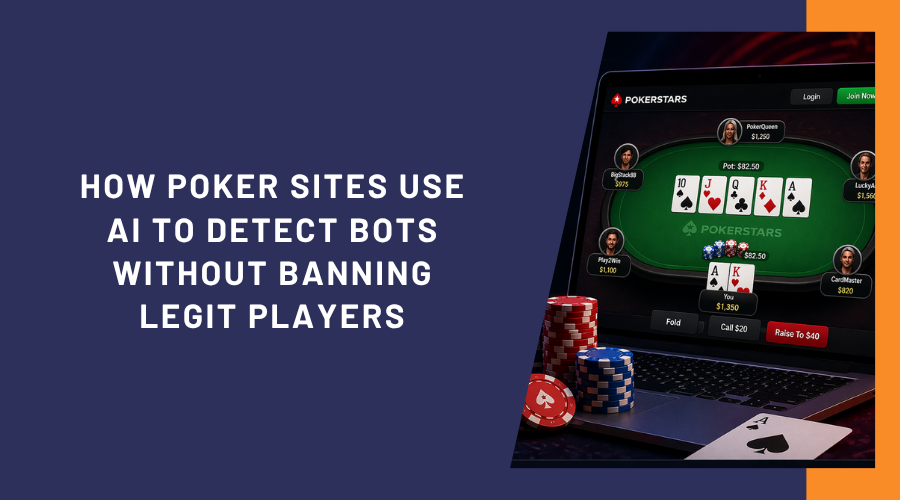
How Poker Sites Use AI to Detect Bots Without Banning Legit Players
Online poker in the U.S. has become significantly more secure over the past few years, largely due to advances in artificial intelligence. At the same time, a growing number of legitimate players report being flagged or temporarily restricted by automated systems. This creates a practical concern – how to play optimally without triggering anti-cheat mechanisms. Understanding how AI works on US poker sites is now essential for serious players.
- AI systems analyze behavior patterns, not just outcomes
- Consistency and low variance can sometimes trigger false flags
- Device usage and login habits matter as much as gameplay
- Players can reduce risk without sacrificing long-term EV

$250 in Free Bets

150% Bonus - Reduced Juice

$500 Free Play - *Limited Time*
Why AI Anti-Cheat Systems on Poker Sites Are Flagging Real Players
AI-driven security tools are designed to detect bots, collusion, and multi-accounting. However, these systems often rely on pattern recognition, which can blur the line between automated play and highly disciplined human strategy. As a result, strong players with consistent habits sometimes fall into “risk clusters.”
This issue has become more visible as more online poker sites adopt real-time monitoring instead of post-session reviews. According to state gaming reports from New Jersey and Michigan (2023), operators have increased automated flagging thresholds to respond faster to threats. The trade-off is a higher rate of false positives.
How AI Detection Works on Online Poker Sites in 2026
Modern AI detection combines several layers of analysis, each designed to identify different types of suspicious behavior. These systems operate continuously during gameplay and across sessions.
Real Time Behavioral Tracking in Online Poker Games
AI models track decision timing, bet sizing, and reaction patterns. They compare this data to known human and bot benchmarks. Extremely consistent timing or near-perfect strategy execution can raise flags.
Device Fingerprinting and Multi Account Detection Methods
Sites collect device-level data such as browser configuration, IP behavior, and hardware identifiers. This helps detect multiple accounts or shared access patterns. Even legitimate multi-device usage can appear suspicious if not consistent.
Machine Learning Models Used by US Poker Sites
Machine learning systems are trained on large datasets of known bot activity. These models evolve over time, adapting to new cheating methods. However, they can misinterpret advanced human play as automated behavior.
|
Detection Method |
What It Tracks |
Risk for Legit Players |
|
Behavioral analysis |
Timing, bet patterns |
High if too consistent |
|
Device fingerprinting |
Devices, IPs |
Medium with VPN use |
|
ML pattern matching |
Strategy similarity |
High for GTO players |
Why Advanced Poker Players Are Mistaken for Bots
The closer a player gets to theoretically optimal play, the more their decisions resemble algorithmic outputs. This creates a paradox where improvement increases detection risk.
GTO Strategy and Solver Based Play Patterns
Game Theory Optimal (GTO) strategies aim for balanced, mathematically sound decisions. These patterns often mirror solver outputs, which AI systems associate with bots. This is especially true in mid to high stakes games.
Consistent Decision Making That Triggers AI Alerts
Humans naturally vary in timing and decision quality. Players who maintain near-perfect consistency across sessions stand out. AI systems may interpret this as non-human behavior.
Low Emotional Variance and Human Like Signals
Most players show emotional fluctuation – tilt, hesitation, or irregular betting. Highly disciplined players with minimal variance can appear artificial to detection systems.
Pro tip: Introduce slight timing variation in decisions to mimic natural human behavior without changing your strategy..
How Poker Sites Are Reducing False Positives with Smarter AI
Operators are aware of false positive issues and are refining their systems. The goal is to improve accuracy without weakening security.
- Hybrid AI Systems Combining Behavior and Context – New models combine gameplay data with contextual factors such as session length and historical patterns. This helps distinguish between bots and experienced players.
- Manual Review Systems for Flagged Accounts – Most major online poker sites now include human review layers. Flagged accounts are escalated before action is taken. This reduces automatic bans and improves fairness.
- Player Profiling and Long Term Data Analysis – AI systems now evaluate players over longer timeframes. Short-term anomalies are less likely to trigger penalties if long-term behavior appears human.
How to Avoid Being Flagged by AI on Poker Sites
Players can take practical steps to reduce risk while maintaining strong performance. The goal is not to “trick” AI, but to avoid patterns that resemble automation.
- Adjusting Play Style Without Losing Profitability – Small adjustments such as varying bet timing or occasionally deviating from perfect GTO can reduce detection risk. These changes do not significantly impact long-term EV.
- Avoiding VPN and Multi Device Risk Factors – Frequent IP changes or device switching can trigger security alerts. Use consistent setups whenever possible.
- Keeping Account Activity Transparent and Consistent – Avoid unusual login patterns or abrupt gameplay changes. Stability helps AI systems classify your account as legitimate.
Step by Step Guide to Reduce AI Flags
1.) Review your session patterns – Identify if your timing or bet sizing is overly consistent.
2.) Standardize your setup – Use the same device and network to avoid fingerprinting issues.
3.) Limit session switching – Avoid jumping between multiple tables or formats too quickly.
4.) Track your own data – Use tracking tools to understand your behavioral profile.
5.) Introduce natural variation – Add slight timing differences to decisions without changing logic.
Pro tip: Playing shorter, focused sessions often looks more human than marathon sessions with identical patterns.
|
Do |
Don’t |
|
Use one primary device |
Constantly switch devices |
|
Maintain natural timing variation |
Act instantly every decision |
|
Play within normal session limits |
Run extremely long identical sessions |
The Future of AI Security on Poker Sites and What It Means for Players
AI security will continue to evolve alongside player behavior. Regulators in states like Pennsylvania and Nevada are already pushing for more transparent review processes and clearer appeal systems.
Players can expect better balance between security and fairness, but also stricter monitoring overall. Understanding how these systems work is becoming part of modern poker strategy, especially for regular grinders.
FAQ's
Why was my poker account flagged as a bot?
Most flags are triggered by behavioral patterns such as consistent timing or solver-like decisions. It does not necessarily mean wrongdoing, but it may prompt a review.
Can using a VPN get me banned on poker sites in the USA?
Yes, especially on regulated sites that require geolocation verification. VPN use can conflict with compliance rules.
Do poker sites use AI in real time?
Yes, most major poker sites use real-time monitoring systems to detect suspicious behavior during gameplay.
How can I prove I am not a bot?
Sites may request identity verification (KYC – Know Your Customer) or conduct manual reviews. Providing consistent account history helps.


Chat
Rules
The goal of chat is to talk sports and sports betting! Help each other by sharing picks and having a good time!
Below will not be tolerated
You can chat about most things to a certain extent. Exception is absolutely NO talking about Religion or Politics.
- There will be NO talking about others or their families
- There will be NO name calling.
- There will be NO rambling on or repeating the same thing over and over.
- There will be NO racist or sexist comments.
- There will be NO posting of other websites.
Basically treat others the way you would like to be treated.
Break the rules

- 1st warning a 24 hour ban
- 2nd warning 7 day ban
- 3rd warning a lifetime ban